Snippets of Information
Architecture / Sculptures / Statues
Stepwells
Stepwells were quite popular in olden days as they were the source of
water for drinking and other household needs. They are known as vav in
Gujarati and as Baoli in Rajasthani, and are popular especially in
semi-arid regions of Gujarat, Rajasthan.
Source: ahmedabadtourism.in
* 27 Oct 2026
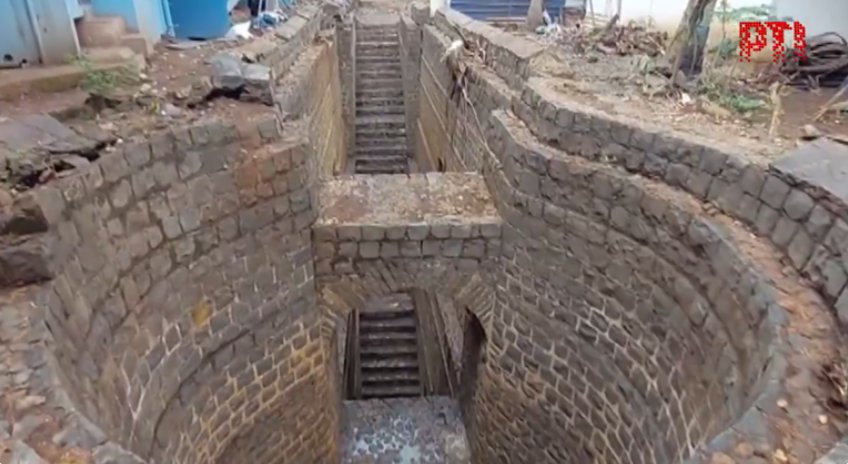
Image Source: ET Online
Shiva Lingam-shaped stepwell at Belagavi
A centuries-old stepwell located in Kanchveer Nagar of Mutga village,
Belagavi district, Karnataka has been given a new lease of life after
remaining hidden beneath garbage, rubble and silt for nearly three
decades. The stepwell is believed to date back to the Adil Shahi
dynasty, which
ruled parts of the Deccan between the 15th and 17th centuries.
Historians also suggest it may belong to the early Maratha period.
The restored structure, believed to be around 300 years old resembling a
Shiva Lingam when viewed from above features 53 stone steps leading
down to the water source and reaches a depth of nearly 80 feet.
The restoration was carried out by the Pyaas Foundation with financial
assistance from social worker Nitin Khot and active participation from
NSS volunteers and local residents. As excavation progressed, clear
water began flowing from the base, demonstrating the effectiveness of
traditional water-harvesting systems that were designed centuries ago.
Source: Once buried under garbage for decades, a 300-year-old
Shiva Lingam-shaped stepwell revived in Karnataka: Historic well draws
crowd in Belagavi, ET Online, 5 Jul 2026
300-year-old stepwell restored in Karnataka's Belagavi after years under debris - PTI News YouTube
* 18 March 2022

The 300 year old stepwell at Myllucharlla Village in Chandra Sekhara
Puram Mandal in Prakasam District of Andhra Pradesh is considered to be
built by the 'Gandi brothers', both cattle farmers, at a place in the
Nallamalla forests. It was built in the 17th century and is source of
pure drink-ing water within the fluoride affected region.The shape is
variously described as diya, horseshoe, shivalinga.
Source: Parched A.P. village saved by 300-year-old stepwell by S. Murali, The Hindu, April 19, 2018
* 5 March 2022

Adalaj ni Vav, 15th-century stepwell, representing the
Indo-Islamic fusion architecture has intricate carvings on the pillars
that support the five storeys. The opening in the ceilings above the
landing allows light and air to enter the octagonal well, but direct
sunlight never touches the steps except at noon. It is said that the
temperature inside the well is six degrees cooler than outside. The
stepwell has three entrances. The stairs lead to an underground storey,
which has an octagonal opening on top. The walls are covered in
ornamental carvings with mythological and village scenes. Some of them
include Ami khumbor (a pot that contains the water of life) and the Kalp
vriksha (a tree of life) carved out of a single slab of stone. There is
a belief that the small frieze of Navagraha (nine-planets) towards the
edge of the well protects the monument from bad omens.
Source: gujarattourism.com
* 5 March 2022
Adalaj Ni Vav is in Adalaj village, near Gandhinagar, Gujarat state capital, and about 18 kilometres from Ahmedabad.
Hindu King Rana Veer Singh started construction of the Adalaj ni
vav to provide relief to his people in this arid region, who had to walk
miles for water. However, before it was finished, he entered into a war
with neighboring Muslim King Mehmud Begada. King Rana Veer Singh was
killed in battle, and King Mehmud Begada fell in love with his widow,
the beautiful Queen Roopba (aka Queen Rudabai).
Queen Roopba agreed to marry King Mehmud Begada-but only on the
condition that he finish the stepwell her husband had started. King
Mehmud Begada agreed, which is why the stepwell design-built in Solanki
style of architecture and adorned with Hindu and Jain images-also shows
Islamic influences.
When it was finished, Queen Roopba threw herself in to the well, and
died. Apparently, she had no intention of marrying King Mehmud-she just
wanted to see her husband’s stepwell finished. Luckily, King Mehmud did
not destroy the structure or the Hindu ornamentation, and it remains
intact more than 500 years later.
Source:
|


